4 November 2024
In a recent PMI article, systems thinking was proposed as a way to enhance project management outcomes. Organisations and project managers increasingly grapple with complex challenges that defy simple models, but it’s almost a meme that ‘over 70% of organizational change initiatives fall short of expectations’.
Researchers face seemingly unrelated factors when trying to understand why, and linear thinking tools struggle with this complexity. While project managers turn to systems thinking (ST) tools, applying them without understanding the underlying ST laws and principles may limit their benefits.
The full paper, available to download, outlines what we mean by complex projects, Systems Thinking, emergent properties and benefits management, and proposes the benefits of combining these to aid successful project delivery. Read on for highlights from the full paper.
A complex project is one with many factors to consider, including a high volume of interdependencies, diverse stakeholders, and significant uncertainty. These projects can't be easily predicted or controlled, requiring flexible and dynamic management methods. Unlike more ‘simple’ projects with clear objectives, complex projects are unpredictable and require a different approach that considers their uncertain and evolving nature. Systems thinking is often used to make sense of these projects, which can range from large scale construction to defence procurement endeavours, where the systems thinking techniques are beneficial from start to finish.
Systems thinking is not just an alternative to traditional project management methods like agile, but a mindset that enhances all types of complex projects. Even simple projects with minimal risks can benefit from ST, as it lays the groundwork for handling more complex tasks in the future. BMT's model (Fig. 1) shows that with more uncertainty and increased risk levels, the more beneficial ST is to a project. It also highlights that ST supports projects of any complexity, regardless of the management approach. For example, combining ST with stakeholder management can lead to a deeper understanding of not only the project’s challenges but also its context and wider organisational issues, promoting greater stakeholder engagement and support for the project's objectives.
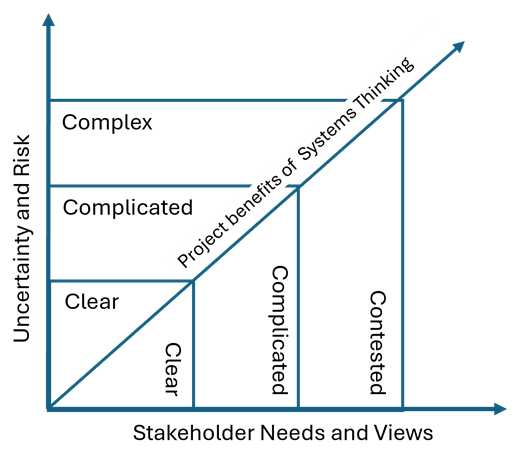
Figure 1: The benefits to a project of using Systems Thinking increases with the level of uncertainty and stakeholder needs and views associated with the project.
Having made the case for adopting a ST mindset for projects of different levels of complexity, it’s also worth considering the concept of ‘emergent properties’, which allows the project manager to refocus away from the components of the project to the properties that the project components create, as they work together to create the expected benefits.
Emergent properties are key in ST, emerging from the interactions within a system that can't be seen in the isolated parts. Take a car: it transports people quickly, but its individual parts can't do this alone. It's the whole car working together that gives it this ability. When mapping out the benefits of a system, focus on these emergent properties rather than the outcomes of each part.
Project management involves identifying and tracking benefits, which are measurable improvements that meet stakeholders' needs and contribute to organizational goals. The Association for Project Management emphasizes the importance of understanding stakeholders' needs throughout a project's life, and a project manager must select stakeholders carefully and define desired outcomes to ensure benefits are realized. While the concept of benefits is broad, involving any positive outcome from work organization, the challenge lies in determining which benefits are most significant and whether they would occur without the project. Open-minded consultation with stakeholders is advised to identify all potential benefits and drawbacks.
We suggest focusing on the overall benefits a project can deliver, rather than just the needs of stakeholders or project deliverers. Systems thinking emergent property analysis aids the identification of the beneficial interplays between stakeholders (or other elements) within the delivery environment. For example, while individual departments like engineering and accounting may achieve their goals, the true measure of success is when they work together to produce cost-effective results, like making 1000 widgets at £1000. This ‘cost per unit’ is an emergent property, which means it’s a result of the entire organization’s efforts, not just one part.
When each department has separate goals, it can lead to conflict. Instead, they should aim for a shared goal, such as producing widgets at a lower cost and with reduced pollution. By focusing on these emergent properties, project managers can better guide the project towards strategic benefits, rather than getting side-tracked by individual stakeholder interests or isolated departmental achievements.
In project management, it's crucial to integrate systems thinking from the start. This approach helps identify and solve the right problems early on, avoiding complications later in the project. Regularly checking for complexity allows for adjustments and ensures the project stays on track. Systems thinking and understanding emergent properties, is key for project managers to realise efficient results and for consultants to handle complex projects effectively. It leads to better decision-making, agility, and long-term organisational resilience.
 Connect with Jemma on LinkedIn
Jemma has 5 years project management experience within the public sector, managing projects of varying complexity, and has recently joined BMT as a Consultant.
Emes, R. and Griffiths, W., 2018. Systems thinking: How is it used in project management? Association for Project Management. Available at: https://www.apm.org.uk/v2/media/bfjjgz0j/systems-thinkingfinal.pdf (Accessed 21 December 2023)
Hoverstadt, P. (2022). The Grammar of Systems: From Order to Chaos & Back. SCiO.
HM Government (2017) Guide for effective benefits management in major projects. Infrastructure and Benefits Authority

Jake Rigby - UK / Europe
Discover how AI can help shipowners, operators and engineering teams navigate decarbonisation, regulatory complexity and operational challenges through improved decision-making and knowledge management.

Dr Tim Curtis
This paper addresses that reality. We introduce a practical way to diagnose transformation maturity while the organisation is still in motion. The Strategy Canvas helps leaders make sense of what is really happening across the whole organisational system.

Chloe Yarrien
Maritime Autonomous Systems (MAS) are moving from concept to operational reality. Across defence and commercial maritime sectors, organisations are exploring how autonomy can improve operational effectiveness, increase persistence, reduce risk to personnel and enable new ways of working.

Dr Thomas Beard - UK / Europe
John Bensalhia from the IMarEST talks to Thomas Beard and Jake Rigby, about the potential benefits, difficulties and future outcomes of making nuclear-powered vessels a reality.