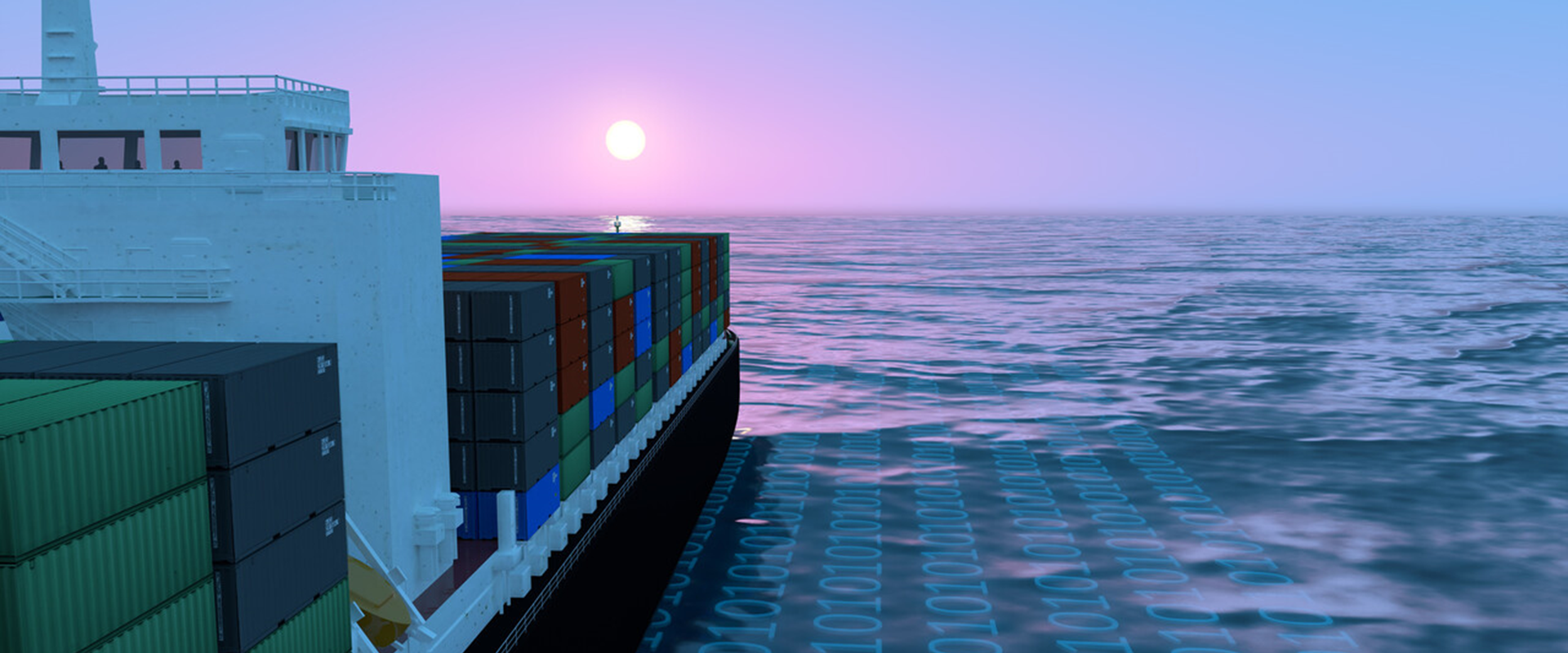
Autonomy is a word that has been used increasingly over the past few years and it is being hailed as a promising technology that can disrupt and lead to many benefits in the maritime sector. What is autonomy to you and what does it offer?
Autonomous systems undertake and enact complex decisions in place of, or in addition, to a human. In practice, autonomy is a range or spectrum dependent on the degree to which the human is in-the-loop, and has, as such, given rise to numerous scales that attempt to capture this spectrum. For any mode of transportation such as maritime, autonomy can apply at varying levels from individual equipment up to the whole platform and in undertaking individual function or task up to a given operational remit. In having to bound the remit or operational domain to include limited off-design eventualities, a purist interpretation of full or end-to-end autonomy is not a practicable notion in the maritime sector, at least yet.
Autonomy is demonstrating its worth in ‘dull or dangerous’ maritime applications - from carrying out data collection for marine science to countering underwater mines. Further applications will undoubtedly emerge as the acceptance grows and the underlying technology advances.
Some have argued that beyond removing the human from immediate harm’s way, autonomy can further contribute to safety at sea by mitigating human error. I think this is misguided because incident and accident statistics disguise the countless hours of operation that pass by without dangerous event due to vigilance and expert decision-making of skilled seafarers. In terms of future human versus autonomous operation, it’s not an either-or question and maximising benefit to maritime hinges on striking a harmonious balance that exploits the pros whilst mitigating the cons on either side.
The Maritime Autonomy Sector is growing rapidly and is wide-ranging and diverse. What area excites you the most, and why?
Given the broad definition of autonomy explained above, it has potential for application across the entirety of the maritime industry so military and commercial vessels, underwater and surface borne, and coastal, offshore, and inshore.
What excites me is the potential for customer pull or supplier push in what are, at first glance, unlikely applications and so catch you off-guard. In a previous role at Rolls-Royce, passenger ferries did not feature in our initial expectation of early adopters of maritime autonomy because we thought that cargo transportation was an easier sell. However, Finferries was amongst first to show interest in uncrewed operation given their vast number of ferries in remote locations and hence the “AAWA” demonstrator came about. Autonomous commuter ferries have since been mooted for busy cities such as Paris, France, Fredrikstad, Norway and even demonstrated in Stockholm, Sweden.
The global autonomous vessel market is expected to grow from around $2.3billion in 2023 to over billion by 2028. Where do you think the biggest opportunities exist?
I’ll have to dust off my crystal ball…. If only I had one! In all seriousness though, this is a hard question to answer not only given my answer above but also because key technologies are developing at pace. I think that a key opportunity for us is simulation-as-a-service building on what BMT has demonstrated with REMBRANDT and assurance of autonomous navigation but also by exploiting other in-house modelling and finding other angles. For example, simulation can provide a low-cost means to prototype Human-Machine Interface (HMI) concepts at the start of the engineering lifecycle, for operators working alongside autonomy and then to train these operators on productionised HMIs prior to in-service introduction.
As an engineering consultancy, what interesting niche experience or expertise do you think BMT has that make us stand out in an emerging market?
Autonomy is an enabler to the evolving maritime landscape and subsequent market opportunities, and not an end in itself. Being able to stand back and understand the implications of autonomy across a vessel and its operations, all from a solution-agnostic viewpoint, is BMT's niche. This understanding is a unique combination of engineering knowledge breadth, in-service know-how and an appreciation of what makes autonomy tick. Without vested interest in particular technology or implementation, our independence allows us to drill down to what really matters.
When it comes to machine learning (ML) and artificial intelligence (AI), how big a part do you think these enabling technologies will play in the proliferation of maritime autonomy specifically?
I find no strict definition of AI to be universally adopted but, in practice, it is often conflated with ML. At the risk of opening a can of worms, I offer the following interpretations of these technologies. ML is mimicking human learning essentially through data driven pattern recognition. AI, on the other hand, is mimicking human decision making via software-implemented algorithms. Attaching sensors and effectors to AI is then what enables an autonomous system to undertake or enact decisions. I personally interpret AI to be broader in remit than ML; for example, to include the mathematical optimisation that is well established for robotic path planning and has thus been implemented for autonomous navigation. As such AI is a pivotal building block for maritime autonomy. Meanwhile, given the pace of ML development, it will undoubtedly grow in its adoption and will make for an exciting future.